


Manhattan Associates and Descartes
Are Overkill for Most Warehouse Operations
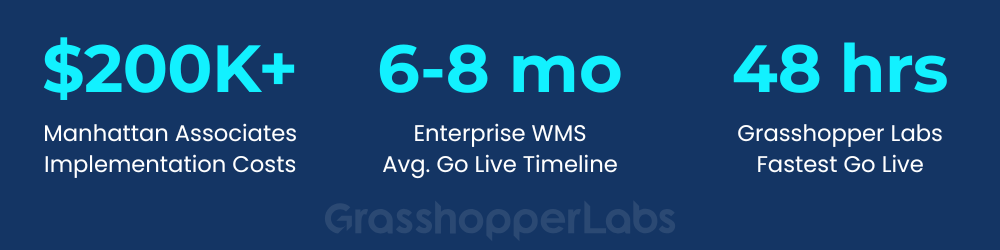
Enterprise WMS platforms cost $200K+ and take 12 months to deploy. If you run a last mile delivery operation, you need a different approach.
If you are evaluating warehouse management software right now, Manhattan Associates and Descartes have probably landed on your shortlist. They should. They are Tier 1 WMS platforms with decades of enterprise track records.
Manhattan is a 17 time Gartner Magic Quadrant leader. Descartes has a massive portfolio spanning route planning, fleet management, and global trade compliance.
But here is what nobody tells you during the sales process: these platforms were built for operations shipping 50,000+ orders a day.
If you are a last mile carrier, a 3PL running white glove deliveries, or a regional delivery company managing a handful of warehouses and a fleet of trucks, you are buying a commercial jet when you need a pickup truck.
We’re not saying Manhattan and Descartes are bad products. They are excellent at what they do.
But after years of running Deliveright and now building Grasshopper Labs, we have watched too many mid market logistics operators spend six figures and half a year implementing software that was never designed to fit their needs.
What this post covers:
- The real cost of enterprise WMS implementation (it is not just the software)
- Where Manhattan and Descartes excel and where they create unnecessary complexity
- What a right sized WMS looks like for last mile and big and bulky operations

The Implementation Reality Nobody Warns You About
Let me be direct about what you are signing up for with a Tier 1 WMS.
Manhattan Associates: The Numbers
Manhattan Active WM implementation costs range from $200K to over $1M depending on your deployment complexity. Implementation timelines run 6 to 18 months.
That is not a typo.
Even mid sized companies report $50K to $100K in implementation costs with timelines stretching to 12 months.
On top of that, you will need a dedicated IT team or a certified implementation partner to keep it up and running.
Manhattan’s own documentation describes the process as requiring a structured partnership with a dedicated team to manage process re-engineering, system integration, and change management.
And here is the part that stings: customization and modifications are expensive and slow.
Users on review sites report that software updates can cause them to lose existing customizations, and rebuilding them on newer versions takes significant time and budget.
Descartes: Similar Story, Different Packaging
Descartes offers more product variety.
Their Peoplevox WMS targets ecommerce brands and goes live in 8 to 12 weeks.
Their core logistics platform is a different animal entirely, with industry reviewers noting complex implementations that require significant IT, business process, and end user training.
Pricing starts at $1,000 to $2,050+ monthly for the WMS alone, with implementation costs on top.
Descartes also has a notable gap for last mile operators: their WMS and their route optimization/fleet management products are separate modules in a massive portfolio.
Finding and configuring the right combination of modules for appointment based, big and bulky delivery is not straightforward.
What These Costs Actually Mean for a Mid Market Operator
Let me do the math on what an enterprise WMS implementation looks like for a typical 3PL or last mile carrier running 20 to 50 trucks across 2 to 3 locations:
- Software licensing: $2,000 to $5,000/month.
- Implementation: $50,000 to $200,000 one time. Timeline: 6 to 12 months before you see value.
- Internal resources: at least one dedicated person managing the project for half a year.
- Integration costs: $10,000 to $50,000 to connect with your TMS, ERP, and EDI partners.
The total cost of ownership in Year 1 can easily reach $150,000 to $350,000.
For a mid market operator, that number represents a meaningful chunk of annual revenue being sunk into software before a single operational improvement is delivered.
Who Manhattan and Descartes Are Actually Built For
I want to be fair to both platforms because they serve their target customers well.
Manhattan Associates Is Built for Mega Distribution
Manhattan excels when you are running massive distribution centers with hundreds of warehouse workers, complex wave picking operations, robotics integration, and multi channel fulfillment across wholesale, retail, and direct to consumer simultaneously.
Their Warehouse Execution System that coordinates robotics and human labor is impressive. Their AI driven labor management can boost productivity by up to 20%.
If you are Nike, Walmart, or a Fortune 500 retailer shipping millions of units daily, Manhattan is the right call.
If you are a 3PL receiving products daily, and possibling staging and dispatching delivery crews, Manhattan’s complexity works against you.
You are paying for capabilities you will never use while missing features you actually need, like integrated route optimization, appointment based customer scheduling, and driver mobile apps purpose built for delivery crews.
Descartes Is Built for Ecommerce Fulfillment and Global Trade
Descartes’ WMS products (Peoplevox, OzLink, Sellercloud) are tuned for DTC brands shipping small parcels at high velocity.
Their route optimization and fleet management tools are separate products designed for food and beverage distribution and high frequency delivery routes.
For a time-constrained delivery operator, you end up needing multiple Descartes products that were not designed to work as a unified system for your use case.
Their route planning assumes standardized stop types, not the variable service times of white glove delivery where one stop is 5 minutes and the next is 45.
Head to Head: What You Actually Need vs. What They Offer
| Capability | Manhattan | Descartes | Grasshopper |
|---|---|---|---|
| Unified TMS + WMS | ✗ Separate products | ✗ Separate modules | ✓ Single platform |
| Go live timeline | 6 to 18 months | 8 to 12 weeks | Days to 2 weeks |
| Implementation cost | $50K to $1M+ | $10K to $50K+ | Included |
| Appointment scheduling | ✗ Not native | ✗ Not native | ✓ Built in |
| Two person crew dispatch | ✗ Not designed for this | ✗ Not designed for this | ✓ Native |
| Customer self service | ● Add on | ● Limited | ✓ Built in |
| Native EDI (204/214/210) | ✓ Yes | ✓ Yes | ✓ Yes |
| Big and bulky optimized | ✗ Generic warehouse | ✗ Parcel focused | ✓ Purpose built |
| Best fit | Fortune 500 DCs, 50K+ orders/day | DTC ecommerce, parcel fulfillment | Last mile carriers, 3PLs, delivery ops |
What a Right Sized WMS Actually Looks Like
The mid market logistics operator needs something fundamentally different from what Tier 1 enterprise vendors sell.
Unified TMS+WMS, Not Separate Products
This is the core issue.
Manhattan sells a WMS. If you need transportation management, that is a separate product (Manhattan Active TM).
Descartes sells WMS products and route optimization products and fleet management products. Each one requires its own implementation, its own licensing, and its own integration effort.
For a last mile carrier or 3PL, the warehouse and the truck are two halves of the same operation. An item gets received, inspected, stored, staged, loaded, and delivered.
If your WMS and TMS do not share the same database and the same user interface, you are creating handoff points where data gets lost, inventory drifts, and orders end up on the wrong truck.
Grasshopper was built as a unified platform from day one because we lived this exact problem when we built Deliveright.
We got tired of running separate systems for warehouse and delivery, then spending hours every day on CSV uploads between them.
Having everything on one platform from the dock to the customer’s door, eliminates that gap entirely.
Days to Go Live, Not Months
At Grasshopper, straightforward single location setups go live in as little as 48 hours.
Complex multi terminal operations with API & EDI integrations take one to two weeks.
Not six months. Not a year. The difference is architectural.
Grasshopper Labs has native API & EDI integrations, while enterprise WMS platforms require extensive process re-engineering because they were designed for generic warehouse workflows that get customized to your operation.
Grasshopper was purpose built for last mile logistics workflows.
Receiving, putaway, staging, route building, dispatch, and delivery tracking are native capabilities, not modules you configure from scratch.
Purpose Built for Delivery Operations
Here is what you should not have to customize or bolt on:
- Appointment based customer self scheduling.
- Two person crew assignment and dispatch.
- Service level configuration (threshold, room of choice, assembly, haul away).
- Photo based proof of delivery with damage documentation.
- Driver mobile apps designed for delivery crews, not warehouse pickers.
- Native EDI support (204, 214, 210) for retail partners.
- Real time customer communication that adapts to the service level of each order.
Every one of these capabilities requires customization or third party integrations on Manhattan and Descartes.
On Grasshopper, all of this is built in from day one.
The Real Question Is Not "Which WMS Is Best" But "Which WMS Fits"
Manhattan Associates is a great WMS. Descartes makes solid products. But “great” and “right for you” are not the same thing.
If you are processing 50,000+ orders a day through massive distribution centers with robotics and multi channel fulfillment, go with Manhattan. That is their sweet spot.
If you are a fast growing DTC brand shipping small parcels and need a WMS that integrates with Shopify and NetSuite, Descartes Peoplevox is a reasonable choice.
If you are a last mile carrier, 3PL, or warehousing operation that needs warehouse management with transportation management in a single system, with appointment based scheduling, crew dispatch, and white glove delivery support baked in, neither of those platforms were built for you.
We built Grasshopper for operators like us.
People who run trucks and warehouses and know that the handoff between the two is where operations break down.
People who need to be live in days, not months, because every week on the old system is a week of manual workarounds and preventable failures.