


Warehouse Visibility:
The True Costs of What You Can’t See
When pick times start slipping, your warehouse team notices. Orders back up, teams scramble to keep up, and small delays snowball into bigger problems.
More often than not, the root cause is a lack of warehouse visibility. Anywhere you have a blind spot in real-time inventory or fulfillment, you’re losing time, money, and resources.
That’s what a warehouse management system is supposed to fix. It shines light into the dark corners so you can see clearly, make better decisions, and move with precision.
Let’s take a closer look at where these blind spots tend to hide and how tech forward warehouse teams are eliminating them.
The Big Warehouse Visibility Takeaways
- Poor visibility drives guesswork, rehandling, and labor waste
- Delayed inventory data breaks the flow between pick, stage, and ship
- A modern WMS reflects floor reality in real time, keeping teams aligned and in control

Warehouse Management System Blind Spots: Costly Factors
It’s tough to take a step back when you’re on the fulfillment treadmill every day. A clunky process starts to feel “normal” when the orders keep coming and you’re in “survival mode.” Nobody can be expected to break down the logic of warehouse optimization on top of the regular daily burden.
We’ve routinely helped warehouse and fulfillment teams drive dramatic double-digit gains in warehouse utilization and fulfillment time. When we talk to frontline people, these are the barriers between their team and those gains:
The Process Spans Multiple Devices and Tools
Without a single view of inventory in a WMS system, you’re hopping from one tool to locate a product, another to track shipments, another to talk to a customer. It’s even more aggravating when a vital piece of info is hiding in somebody’s head instead of the system. Then you have to go track them down.
“We’re Still Not 100% on Where Everything Is.”
Pick time and accuracy hinge on the warehouse management system that pinpoints everything up to the minute. Otherwise you’ve got a general efficiency drag that adds up between the line items of the budget — and problems that roll into delivery and affect customer satisfaction.
There’s Still Too Much Manual Entry and Too Many Mistakes
An order number or SKU gets punched into a smartphone by a teammate in a hurry. Now we’re in a scenario where the wrong item gets pulled or we’re chasing a “ghost crate.” We’ve burnt up valuable time with double-handling or the wrong order gets put on a truck, taking up valuable space and requiring you to eat the cost of the reverse logistics.
Manual entry is just one symptom of a wider problem: Inconsistent data that throws the warehouse team off the trail and adds up to a huge effect on your bottom line..
You Have to Stop the World for Cycle Counts
Accurate audits are life. But putting other critical activities on pause to get them done steals a ton of time you need for more important tasks.
Assigning and Tracking Tasks
Let’s say you know where everything is with one view. If that view doesn’t also show you who’s acting on it, you’re not getting the full benefit of better real-time intel. This is another flavor of the “disconnected systems” problem we talked about above.
These are a few examples. Other painful symptoms that stem from blind spots in your WMS system:
- Inaccurate staging and loading mistakes (turning into failed deliveries or returns)
- You’re hopping on yet another system to find the right answer to an urgent question
- All these separate solutions eat up more training time and slow onboarding
- The sum cost of all those separate SaaS subscriptions is now pretty big
- Turnover: The grind and the chaos drive off talent
- All the “paid labor with no output”
- Too much time spent processing returns, managing refunds, or re-ships
- Too much idle time or duplicate work
What about the future? You want to forecast with confidence, zap the bottlenecks, and eventually scale the company by using everything smarter. This is where a unified warehouse inventory tracking system gets you out of the shadows for good.
Warehouse Management System: Everything in One View is the New Standard
The new breed of WMS tools deliver on the promise of end-to-end visibility.
This is the foundation that helps your warehouse team get ahead and stay there.
Here are the “must have” pillars of functionality for a WMS system:
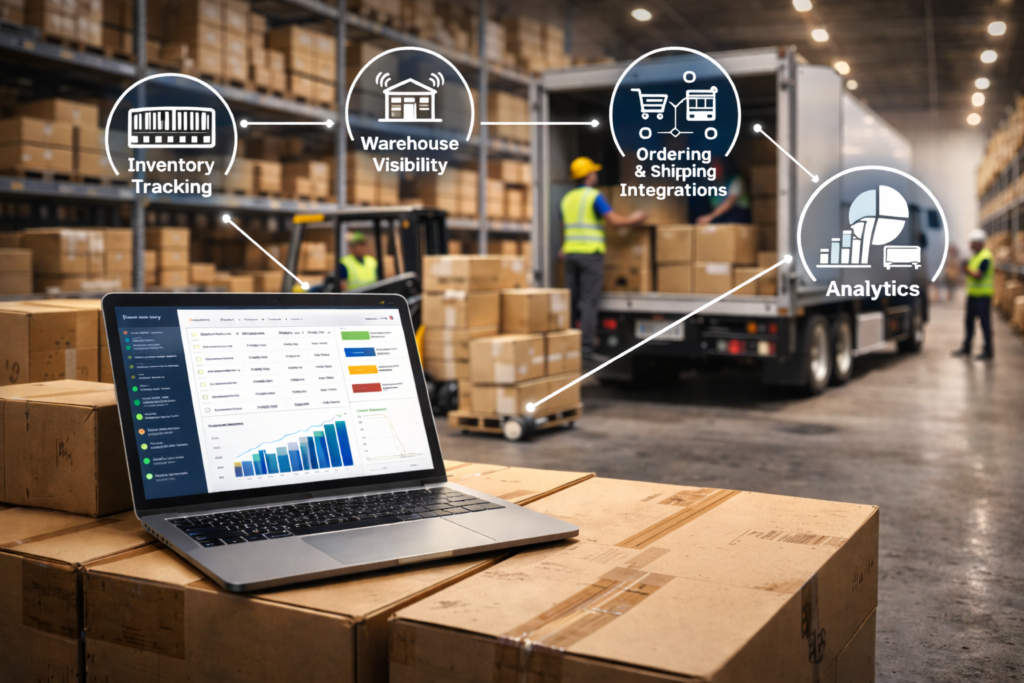
Inventory Tracking
You have to know where everything is at all times. This is especially important for items moving inside the warehouse. Real-time inventory tracking is the ticket to taming inaccurate work across the board and massively reducing situations like stockouts.
Warehouse Visibility
Better decision making at speed — that’s what happens when you can bank on a live view of the entire warehouse. Or even multiple locations. Your warehouse management system should span all locations and items.
Easy Integration with Ordering and Shipping
A modern WMS has to be supremely integrated with your existing solutions in order to manage orders and shipping without losing track of key data. The goal is to stop “platform hopping” and get a single, actionable view of the whole process.
Clean, Consistent Data for Error Reduction
Manual entry errors and inaccurate data stem from disconnected systems that don’t communicate. This results in lost time and slowed processes. Today’s solutions promise accurate product/order data synchronization across platforms via sophisticated APIs. All relevant info is auto-imported, eliminating small leaks that cost time and money.
Rapid-Moving and Mobile-Driven
Cycling through devices creates the same slowdowns as hunting through different apps. Your solution should be efficient and include a warehouse app to help simplify the amount of hardware required to:
- Scan items anywhere in the warehouse to quickly update inventory
- Confirm order details in the warehouse inventory tracking system
- Create labels/QR codes containing all relevant information
- Speed up everything from picking to loading
Where Warehouse Optimization Meets Your Daily Task List
Let’s look at some of the biggest demands on a warehouse leader’s day. Here’s how the new generation of warehouse inventory tracking and management systems should support you at each step:
Smart Order Fulfillment: Automate Those Tasks and Win
Imagine all the new bandwidth in your day when you don’t have to micromanage teammates for picking, packing, cycle count, item relocations, and inspections. Your solution should be able to auto-trigger and assign these tasks. You can track them with a tap whenever you need to check in, allowing you to move faster and more accurately without the extra brain burn.

Continuous Cycle Count: No Need to Hit “Pause”
Built-in cycle count muscle can schedule, assign, and track inventory across locations without having to halt operations.
Inbound and Outbound Coordination
From supplier receiving to customer delivery staging, your warehouse management system gives you full control of product flow.
Take the Headache Out of Reporting
A robust inventory tracking system means you can confidently report on any KPI and know it’s up-to-the-minute accurate — and spot any other snags while you’re at it.
This also improves forecasting and gets you out of a reactive state. With this power at hand, you can:
- Pull a customer order for any inquiry instantly
- Alert a customer about capacity issues
- Pinpoint any box or pallet in your lane of control
Generating Measurable Impact on the KPIs That Matter
For example, imagine the change your team can drive if you consistently cut an item’s seven-minute handling time in half across a big facility.
We have seen companies achieve these kinds of results when they modernize their warehouse management systems:
- 67% Improvement in warehouse utilization
- 80% Faster product discovery
- 35% Faster fulfillment times
- 50% Increase in billing accuracy
Warehouse optimization is all about getting total visibility, seamless coordination, and real-time control. The “time thieves” hiding in everything from pre-inspection to staging to receiving are lit up, and banished with a robust WMS system.
Can Warehouse Optimization Create More Productive Employees Who Stick Around Longer?
You know the feeling when your warehouse team is in a flow state — running tight and in sync. You’ve probably experienced the opposite, too. Nothing seems to go right. Attitudes get frayed. Mistakes start to compound. Morale spirals.
How does having something like a warehouse inventory management system help prevent burnout?
- You’re reducing manual, repetitive stuff — which means your team is working smarter on higher-value goals. They have better feedback from making a bigger contribution and knowing their work matters.
- Redoing work and the feeling of wasted effort drags on your productivity and ultimately, your retention. Features like mobile scanning and accurate task assignment take needless friction, fatigue, and discouragement out of their day.
- Your team is happier because they’re more efficient: A 2025 paper from Journal of Information Systems Engineering and Management showed dramatic improvement in categories like error correction and order accuracy with AI- and IoT-backed warehouse management systems in place.
- You’ve got new tools to increase retention: The warehouse sector remains one of the highest for turnover rates. (US Bureau of Labor Statistics, Job Openings and Labor Turnover Survey News Release)
- Advanced WMS systems can speed onboarding and training.
- The improvement of processes you see with a warehouse management system can also give you the keys to retention: Think improved safety and better conditions.
- Clear tasks and better processes prevent frustration and burnout. Some companies use custom KPIs from their WMS systems to make positive changes that could keep an employee from walking out the door one day and not coming back.
Many of these gains happen when the human element gets the right technology assist.
Source: “Smart Warehousing and Real-Time Inventory Optimization Using IoT and AI,” Journal of Information Systems Engineering and Management
Warehouse Optimization: Why the Leading Warehouses Already Have AI
Warehouse Optimization: Why the Leading Warehouses Already Have AI
According to November 2025 research from Mecalux and the MIT Intelligent Logistics Systems (ILS) Lab, 90% of warehouses have some sort of AI or advanced automation in place.
Regardless of what problem you most want to solve, there is an AI solution to help you do it.
There is a big surge in AI integration because it drives all the things you want to be better at on the floor.
Key takeaways from the research:

- It’s not just pilot programs anymore: AI is becoming a fixture in day-to-day processes like order picking and inventory optimization. Companies polled in the study are committing anywhere from 11-30% of their tech budgets to AI and machine learning.
- It’s also showing up in functions like safety monitoring and equipment maintenance.
- The reinvestment is because the gains are already measurable in inventory accuracy, labor efficiency, and error reduction.
- Logistics companies are onboarding AI because they want to be more agile and adaptive, not just faster.
- 87% of companies polled are increasing AI budgets and 92% are planning new projects.
- A few of the things they want to be better at? Automated documentation, improved warehouse layout/usage, and forecasting.
- Strong data integration is one of the challenges: Getting to the clean data your team needs means your solution must work well with the tools you have today.
- 75% of the companies in the study saw employee productivity and satisfaction go up.
- More than half of these companies actually grew their workforce.
Source: “Study: AI Adoption In Global Warehouse Operations,” Business Facilities
In Review: What Your Next WMS System Should Deliver
Expensive snags are real, but there are now more ways than ever to spot and neutralize them with the right WMS system in place. Warehouse optimization software has grown up fast. We’re entering a new world where “normal” warehouse floor hassles will be distant memories.
The right Warehouse Management System will allow you to:
- Reduce repetitive manual tasks and work on better stuff
- Improve accuracy across inventory, fulfillment, and shipping
- Find more warehouse and fulfillment capacity that was hidden before
- Eliminate bottlenecks that you used to create (and fix) by hand
- Respond faster when outside events change your game plan
- Optimize space, task assignments, and warehouse layout with live data
- Create teams of more effective, more satisfied people
Armed with real-time data and predictive power, new systems will light up every corner of the warehouse and light the way to solving the usual day-to-day drains on time, money, and morale.
Takeaways:
- A single, bright view of real-time data in one place is replacing disconnected systems and processes
- Double-digit improvements in fulfillment time functions can happen almost overnight
- Better warehouse management tools create more effective, happier teams
- An AI-powered WMS will be the co-pilot in your quest for warehouse optimization