


The Hidden Cost of Disconnected Logistics Software
How Running Separate TMS and WMS Platforms Holds You Back
A 3PL operator recently shared something that stopped us in our tracks:
“We run Extensiv 3PL for our WMS and DispatchTrack for our TMS. Unfortunately, they are not integrated, and it causes a lot of CSV uploads from one to another – which is cumbersome to say the least.”
That single sentence captures the reality for hundreds of logistics providers right now. They have invested in best-of-breed point solutions, only to find themselves buried in spreadsheets, manual exports, and duplicate data entry every single day.
This post breaks down exactly why disconnected TMS and WMS platforms create so much friction, and what an integrated TMS and WMS platform looks like.
Summary
- Disconnected TMS and WMS create manual work and data errors
- Lack of integration leads to poor visibility and slower operations
- Unified platforms eliminate friction and improve scalability
TMS vs. WMS - and Why Does Integration Matter?
A Warehouse Management System (WMS) governs everything inside the four walls: inbound receipts, putaway, pick/pack, inventory levels, and outbound staging.
A Transportation Management System (TMS) takes over once freight leaves the dock – routing, carrier selection, dispatch, tracking, and proof of delivery.
In theory, both systems serve distinct purposes. In practice, they share data constantly. An order fulfilled in the WMS must immediately appear in the TMS for routing.
A delivery exception captured by the TMS should immediately update inventory records in the WMS. When the two systems do not talk to each other natively, that shared data has to travel manually – and that is where the problems begin.
Problem #1: The Never-Ending CSV Shuffle

The most immediate pain of running disconnected platforms is manual data transfer.
Teams export order files from the WMS, reformat them to match the TMS schema, then import them – often multiple times a day.
When columns do not align or field names differ between systems, staff spend hours troubleshooting import errors instead of managing freight.
This is not a minor inconvenience.
A LeanDNA survey of 250 supply chain, inventory and planning executives, found that logistics professionals spend about 14 hours per week on manually tracking data that could be automated.
That is 728 hours per year, per employee, that could be going toward customer service, capacity planning, and growth.
“We currently operate under Extensiv 3PL for a WMS and DispatchTrack for the TMS. Unfortunately, these are not integrated and cause a lot of CSV uploads from one to another which is cumbersome to say the least.”
-Grasshopper Labs Prospect
Problem #2: Data Lives in Silos - Visibility Suffers
When your WMS and TMS are separate systems, neither one has a complete picture of the order lifecycle.
Your WMS knows an order shipped. Your TMS knows it was delivered. But who has the single source of truth for billing, exception management, and customer reporting?
In the Extensiv + DispatchTrack scenario, a manager trying to answer a simple customer question: “Where is my delivery and was everything picked correctly?” – must log into two separate systems, correlate order numbers manually, and then synthesize the answer.
Multiply that by dozens of daily inquiries and you have a serious operational drag.
Worse, the data is always slightly out of sync, which means reports and dashboards can never be fully trusted.
Problem #3: Errors Multiply at the Handoff Point
Every time data crosses a system boundary manually, it is an opportunity for error.
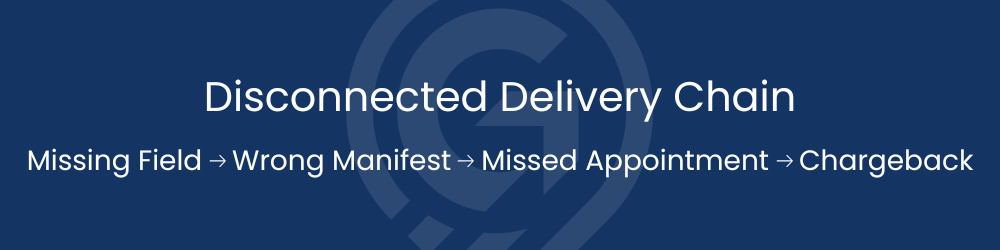
Order quantities get transposed. Stop sequences get lost. Special delivery instructions buried in the WMS notes field never make it into the driver route manifest in the TMS.
A missed field on import can mean a driver showing up at the wrong address, or worse, a missed appointment that triggers a chargeback.
For big and bulky, appointment-based deliveries like furniture, appliances, exercise equipment, these errors are especially costly.
A failed delivery attempt often means a full reschedule, re-routing cost, and a damaged customer relationship.
The root cause in many cases traces directly back to a CSV that did not transfer cleanly between systems.
Problem #4: Billing and Invoicing Become a Nightmare
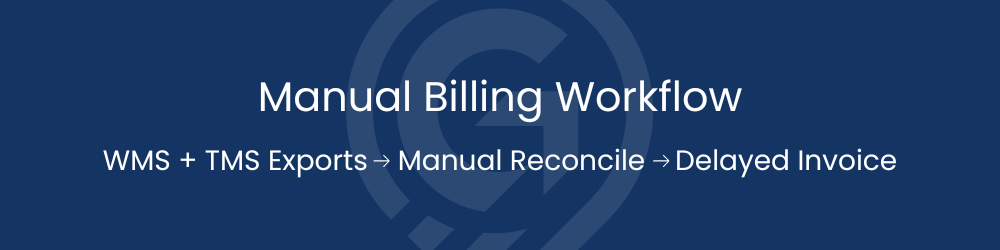
Accurate invoicing requires combining data from both systems: what was picked and packed (WMS) and how it was delivered – including fuel surcharges, accessorials, and stop fees (TMS).
When those systems do not share data automatically, billing teams must manually reconcile two separate exports before they can produce a single invoice.
This slows your billing cycle, increases Days Sales Outstanding (DSO), and creates disputes with customers when charges do not match what the driver communicated at the door.
In a 3PL environment where clients demand itemized transparency, this gap in your systems becomes a gap in your credibility.
Problem #5: Scaling Is Structurally Impossible

Imagine adding a second warehouse location, a new carrier, or a new retail client who sends EDI purchase orders.
Every one of those expansions now requires you to set up and maintain the integration, or manual transfer process in two separate systems, with two separate support contracts, two separate training programs, and two separate upgrade cycles that may not stay in sync.
Companies running disconnected platforms find that their operational overhead grows linearly with volume, rather than the sub-linear scaling you would expect from technology.
When you’re forced to hire more coordinators to manage more CSV exports. The system does not scale – your headcount does.
Problem #6: Customer Experience Is the Ultimate Casualty

At the end of the day, all of these internal inefficiencies show up in the customer experience.
Delayed status updates, incorrect delivery windows, billing disputes, and re-delivery failures all stem from the same root problem: your systems are not speaking to each other.
Customers want real-time tracking, accurate ETAs, and seamless communication.
That is impossible to deliver when your operations team is manually bridging two platforms that were never designed to work together.
The Extensiv + DispatchTrack Reality: A Case Study in Friction

Extensiv 3PL Warehouse Manager is a capable WMS with solid inventory and billing tools for multi-client 3PL environments.
DispatchTrack is a respected TMS with strong route optimization and delivery experience features.
Both are legitimate platforms but they were built independently, and integrating them requires either expensive custom middleware, a third-party iPaaS tool (which adds yet another vendor), or the CSV workflow described at the start of this post.
For operators running this stack today: you are not alone, and it is not a failure on your part.
It is a structural limitation of point solutions that were never designed to share data natively. The real question is how long that friction tax is acceptable before it starts costing you clients.
Running two best-of-breed point solutions does not always equal best performance. Without native integration, you are running one operation on two sets of rails – and every handoff is a risk.
What a Unified TMS + WMS Platform Changes

An all-in-one platform that combines TMS and WMS functionality eliminates the handoff entirely.
Orders flow from receiving through picking, dispatching, and delivery confirmation in a single system of record. There is no CSV export. There is no import mapping. There is no reconciliation at month-end.
More importantly, every stakeholder – from warehouse staff to dispatchers to billing to client-facing account managers – is looking at the same data, in real time.
Exceptions are visible the moment they occur. Billing is generated from the same data that drove the delivery.
And when you add a new client, location, or carrier, you configure it once, not twice.
Key Questions to Ask When Evaluating Your Stack
- How many hours per week does your team spend manually transferring data between systems?
- When a delivery exception occurs, how long does it take to trace it back to the warehouse event that caused it?
- Can you generate a single invoice that reflects both warehouse and transportation charges without manual reconciliation?
- What happens to your operational overhead when you add a new warehouse location or client?
- How confident are you in the accuracy of your real-time inventory numbers, given that your WMS and TMS are not in sync?
The Bottom Line
The era of cobbling together point solutions and managing the gaps with spreadsheets is over.
As logistics operations become more complex with EDI requirements, appointment-based delivery windows, multi-client environments, and growing customer expectations, the cost of disconnected systems becomes impossible to ignore.
Whether you are running Extensiv + DispatchTrack, a legacy WMS paired with a carrier portal, or any other fragmented stack, the math is the same: every manual handoff is a cost center, a risk point, and a ceiling on your growth.
Purpose-built, unified platforms exist precisely to solve this problem.
The question is not whether or not to consolidate, it’s when you should get started.
And it comes down to how soon you want to stop paying the hidden tax of disconnected systems, and start scaling your business.